Hamdi Saidani
 This aromatic, custard-based fig leaf ice cream is made by toasting fresh fig leaves, steeping them in cream and milk for hours, then building a classic egg yolk custard from the infused liquid. It takes some patience, with at least 2 hours of steeping and overnight chilling, but the flavor is unlike anything you’ve tasted.
The fig leaves get toasted in the oven at 325°F for 8 minutes until dry and fragrant. That toasting releases a coconut-like, almost vanilla aroma that’s completely different from the fruit itself. You crumble the toasted leaves into the warm cream and let them steep like tea. Two hours is the minimum, but overnight in the fridge extracts the deepest, most complex flavor. This steeping step is the entire point of the recipe, so don’t rush it.
After straining, you build a standard custard by tempering egg yolks into the infused cream and cooking until it coats the back of a spatula. Strain it a second time to catch any stray bits. The ziplock bag in an ice bath trick cools the base fast and evenly, which is faster and more effective than setting a bowl in the fridge. Churn the next day for the best flavor since the infusion continues to develop overnight in the cold base.
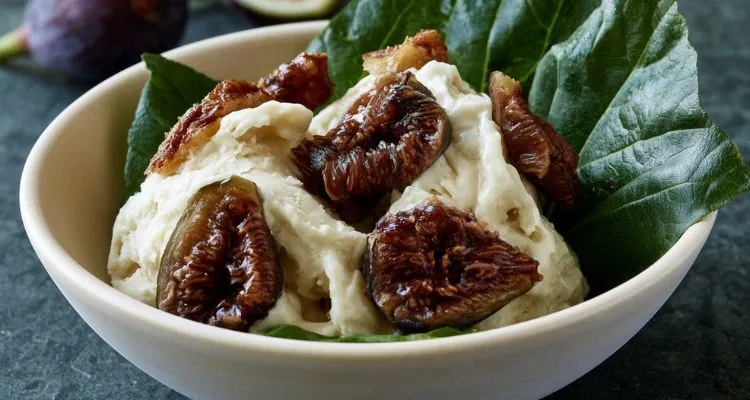
Fig Leaf Ice Cream
Description
This fig leaf ice cream steeps toasted fig leaves in cream overnight, builds a rich egg yolk custard, and churns it into a smooth, aromatic frozen dessert.
Ingredients
Fig Leaf Ice Cream Ingredients
For serving:
Instructions
- Preheat the oven to 325°F. Place the fig leaves on the middle rack and toast for 8 minutes until dry and fragrant. Watch closely so they don’t burn.
- Heat the milk, cream, and 1/4 cup of the sugar in a large saucepan over low heat until simmering.
- Crumble the toasted fig leaves into the warm cream. Keep warm for 5 minutes without simmering.
- Remove from heat, cover, and steep for a minimum of 2 hours. For the strongest flavor, steep in the fridge overnight, up to 8 hours.
- Strain the infused cream through a fine mesh strainer into a clean saucepan, discarding the solids. Heat over low until simmering.
- Whisk the egg yolks and the remaining 1/4 cup of sugar in a large heatproof bowl until pale.
Slowly whisk 1/4 cup of the hot cream into the yolks to temper. Add another 1/4 cup, whisking constantly. - Pour the yolk mixture back into the saucepan. Cook over medium heat, stirring constantly, until the custard thickens and coats the back of a spatula, about 15 minutes.
- Strain the custard through a fine mesh strainer into a clean container. Pour into a gallon zip-top bag, seal, and submerge in an ice bath until cold, about 30 minutes. Refrigerate for at least 4 hours or overnight.
- Churn in an ice cream maker according to the manufacturer’s instructions until it reaches soft-serve consistency, about 25 to 30 minutes.
- Transfer to a storage container. Press parchment directly against the surface, seal with a lid, and freeze for at least 4 hours until firm.
- Serve with quartered fresh figs and chopped pistachios.
FAQs
What do fig leaves taste like in ice cream?
Nothing like the fruit. Toasted fig leaves release a warm, coconut-like aroma with hints of vanilla and toasted hay. The flavor is subtle, floral, and completely unique. People who try it for the first time usually can’t identify what they’re tasting, which is part of the appeal.
Can I skip the overnight steep and just do 2 hours?
You can, but the flavor will be lighter and less developed. The full overnight steep in the fridge gives the cream time to absorb the deepest notes from the leaves. If you’re going to put in the effort of sourcing fig leaves, give the infusion the time it deserves.
Where do I find fresh fig leaves?
From a fig tree, either your own or a neighbor’s. Farmers markets sometimes carry them during fig season. You need the leaves, not the fruit, so ask anyone with a tree. They’re usually happy to share since the leaves are normally discarded. Make sure they haven’t been sprayed with pesticides.
What do I serve it with?
Quartered fresh figs and a scatter of chopped pistachios on top is the intended presentation. For a dessert table, a warm slice of the Fig Almond Cake underneath turns each scoop into a full composed dessert. A plate of the Fig Bars on the side gives guests a cookie option in the same seasonal lane.
Why does the recipe strain the custard twice?
The first strain removes the fig leaf solids after steeping. The second strain after cooking catches any bits of cooked egg or remaining debris. Both steps are essential for a perfectly smooth, clean-textured ice cream with no gritty or leafy bits.